
Adopt a Pet
Your Guide to Taking Home Your New Best Friend
You do not need to live in Detroit - or even the U.S. - to adopt from Detroit Animal Care and Control. You must be at least 18 years old, have valid ID, and proof of your current address.
Adoptable Pets
You can use these filters to narrow down your choices.
Click on the picture to learn more.
Why Adopt
Friends of Detroit Animal Care & Control (FoDACC) believes in the power of love, compassion, and second chances. When you adopt, you give a homeless pet a new lease on life. Adopting pets from shelters or rescue organizations is a compassionate choice that offers numerous benefits, not just for the animals but also for you and society as a whole. Every adoption not only changes an animal's life but also enriches your own. Here are several compelling reasons why adopting pets is a better option than buying them from breeders or pet stores:
-
All adoptable pets at DACC have been spayed/neutered, are up to date on vaccinations (DHLPP, Bordetella, and Rabies), have been heartworm tested and are on preventive, and are microchipped. Detroit Animal Care & Control covers the cost of heartworm treatment at DACC for all fostered and adopted dogs that are heartworm positive.
In addition, each adopted pet goes home with a goody bag provided by FoDACC to get you started, including food, treats, and toys. Dogs also go home with a new harness, collar, and leash. You're not just bringing home a pet; you're welcoming a family member.
-
All adoptable pets have unique personalities and temperaments, and each one has been evaluated by DACC staff to make sure they are suitable for placement with a family. Adoption counselors can help match you with a pet that fits your lifestyle and preferences, ensuring a harmonious relationship between you and your new companion. While we hope that your new pet is the perfect fit, pets adopted from DACC can be returned within 30 days if it isn’t working out.
-
Millions of animals, including dogs, cats, and other species, are euthanized in shelters each year due to overcrowding. By adopting, you're providing a home for an animal in need and saving two lives - the animal you brought home and the one that took its place at the shelter.
-
Adopting from shelters and rescue organizations decreases the demand for puppies bred in inhumane conditions in puppy mills. By adopting, you're taking a stand against the mistreatment of animals in these facilities.
-
When you adopt, you're helping reduce the demand for breeders and pet stores, which, in turn, helps combat pet overpopulation. All adoptable pets at DACC are spayed/neutered, which further contributes to controlling the population of stray and unwanted animals.
How to Adopt
DACC has new dogs and cats available for adoption every day, so check back often if you don’t see what you are looking for. There are two different pathways for adopting a DACC animal, depending on whether the animal is in foster or at the shelter.
If the listing above says the animal is in foster, please send an email to adopt@friendsofdacc.org to arrange a meet-and-greet.
Otherwise, you can meet the animal any day of the week. No appointment necessary. View shelter hours and location here.
The adoption process takes one or more hours, depending on staffing levels and the number of potential adopters. We appreciate your patience!
-
For shelter adoptions, plan to take the animal home that day.
If the animal is in foster, you will meet it one day and adopt it at the shelter on another day.
Bring your whole human family, including children, to meet the animal.
Leave all other pets at home - your adoption counselor will review how to slowly introduce your new pet to your resident pets after a period of decompression.
Bring your state I.D. (drivers license, for example) or City of Detroit I.D. If the address on your I.D. is incorrect, bring proof of your current address, such as a current lease agreement or a current utility bill. We also accept a passport from any country with proof of mailing address, such as a utility bill.
If you have recently brought another animal into your home, wait at least three months before bringing home another pet.
-
Park in the visitors' lot and come in the front doors. Check in at the desk and let them know if you are there to adopt a dog or cat. Browse the binder of available animals with their photos and a report card if they’ve been on a Detroit Dogventure or a Slumber Party.
You can also preview adoptable animals in the listing above.
Choose one or two dogs that you would like to meet.
Your adoption counselor can help you select dog(s) appropriate for your family based on what we know about them.
You will meet the dog(s) and have a chance to interact with them.
-
Talk with your adoption counselor about what you’re looking for in a pet
Meet the animal(s) you selected
Review the care your pet will need in their first days, weeks, and months
-
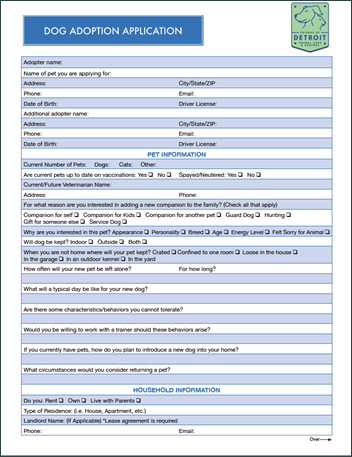
You will complete a short application on paper and staff will make a copy of your I.D. Next, you will review and sign the adoption agreement (if you are fostering the animal, you will review and sign a foster agreement instead).
You can preview the adoption application and agreement below.
There is no adoption fee. There is a suggested adoption donation of $100 to Friends of DACC, but you can pay as much or as little as you like. Adoption donations help us continue to provide things like harnesses and goody bags, training sessions for pets, and enrichment for the animals in the shelter.
-
When the process is complete, you will take your new pet home! Each animal goes home with a goody bag with food, treats, and toys to get you started. Dogs will also go home with a new harness, collar, and leash. You will receive a folder with a copy of the adoption agreement and the medical history and rabies certificate. Included in the folder is tons of great information on bringing a new pet home and what to expect. Check it out here: bit.ly/AdoptionPacket
How to Adopt a Shelter Dog from Detroit Animal Care and Control
Breed Versus Behavior
When adopting a dog, people often want to know their potential pet’s breed. While it’s natural to wonder, visually identifying a dog’s breed can be highly unreliable. Many dogs, especially those in shelters, are mixed breeds with diverse genetic backgrounds. We don’t post the breeds of our adoptable dogs here, because unless we know a dog’s parent history, visual identification is often misleading. Instead, we call them “Detroit Specials”.
Behavior evaluations provide a clearer understanding of a dog’s personality and suitability for your home. Behavior evaluations consider the dog’s personality, likes and dislikes, activity level and energy, and training potential. At Detroit Animal Care and Control, the behavior evaluation process isn’t about passing or failing. Instead, it’s about building a comprehensive profile of each dog’s personality, preferences, and needs. By assessing behavior at multiple touchpoints, we can better understand each dog as an individual and provide adopters with the information they need to find their perfect match.
-
In the Field (if applicable): We note a dog’s temperament and behavior during their initial rescue or intake.
During Intake and Vet Exam: We observe how they handle restraint and medical procedures, including receiving vaccinations.
-
Shelter staff monitor their presence in the kennel, looking for signs of:
Barrier reactivity
Dog reactivity
Human-directed reactivity
-
Outside, dogs are assessed for:
Leash walking skills
Off-leash behavior, including signs of anxiety, confinement issues, or escape attempts
Responses to activities like fetch or general play
Interactions with other dogs if any are nearby
-
Shelter staff assess:
Treat preferences and how they take treats (gently or aggressively)
Knowledge of basic commands like “sit” or “paw”
Food motivation or potential food obsession
General behavior, such as jumping on tables, house-training indicators, or signs of anxiety
Interaction preferences—do they seek out human attention or prefer independence?
Comfort with petting, including sensitive areas like the head, ears, feet, and belly
-
We assess how they respond to excitement and whether they can calm themselves down.
We take photos, evaluate their ability to focus, and note how they react when we get on their level by sitting on the floor.
-
During the walk back, we observe:
Leash skills
Reactivity toward other dogs
Sensitivity to handling (e.g., being head or hand shy)
Signs of potential separation anxiety when returned to their kennel
-
Once sterilized and made available for adoption, we continue gathering insights:
Volunteers document their interactions during walks or playtime.
We send dogs on Dogventures—outings to dog-friendly spots—to observe their behavior in cars, around strangers, children, and environmental stimuli like bikes or busy streets.
Here For All Detroiters
Language should never be a barrier to caring for or adopting a pet. We are #HereForAll, regardless of language spoken or immigration status. We have Spanish interpreters at the shelter every Saturday. Accepted IDs for adopting a pet include:
City of Detroit ID
State ID, such as a drivers license
Passport from any country and documentation of your mailing address, such as a utility bill
Everyone is welcome with Friends of DACC!


Adoption Application and Agreement
Learn more about what to expect by previewing our adoption application and agreement. Just click on the image to open.
Adoption Application
Adoption Agreement

What to Expect After Adopting Your Pet
Pets, like humans, need time to adjust to their new surroundings, routines, and family members. And you need time to adjust to them, as well! That's where the 3-3-3 rule comes in – a simple yet powerful guideline to help your new canine companion transition smoothly and happily into their forever home.
Remember, every pet is unique, and the 3-3-3 rule provides a flexible guideline to ensure a successful transition for your new companion. Cats take about twice as long as dogs to adjust to their new home. Patience, consistency, and understanding are key. By following this rule, you are laying a strong foundation for a happy, well-adjusted, and confident pet who will thrive in their new home.
3 Days
to Decompress
The shelter is a stressful place, and your new buddy needs time to decompress. During the first 3 days, your pet may feel overwhelmed and uncertain. You may notice that they don’t want to eat or drink, or that they hide. Allow them to explore their new surroundings at their own pace. Establish a quiet spot for them, such as a crate or a separate room. Provide a calm and quiet environment, let them sleep uninterrupted in their own designated sleeping spot, and establish a consistent routine for feeding and potty breaks. Keep them separate from any other pets, and limit introductions to only household members. Make sure children let the pet rest. Giving your pet time to feel secure in their new space will put them on the right path.

3 Weeks
to Learn Your Routine
During the first 3 weeks, your pet might start to show more of their personality. They could become more comfortable, but some challenges might arise, such as testing boundaries or exhibiting signs of anxiety. Be patient and understanding. This is a great time to use positive reinforcement to encourage the behaviors you want, and teach or reinforce basic commands. Continue with the established routine, gradually introducing them to different areas of your home and gentle, positive interactions with family members. Slowly introduce them to other household pets, using leashes, baby gates, and crates to control interactions. Feed your pets separately and remove objects that may create conflict, such as beds and toys.

3 Months
to Feel at Home
At about 3 months, your pet should finally feel completely comfortable in their home. They should be settled in and showing all aspects of their personality. Focus on building the trust you have already established, and strengthening the bond between you and your pet. Provide regular exercise, mental stimulation, and lots of love and praise. Continue to monitor your pet’s interactions with other household pets and family members to ensure harmonious relationships.
How to Welcome Home Your New Dog
Bringing a new dog home is very exciting! Watch this video to set your new dog up for success right from the start.
Force-free trainer Zak George goes over how to do dog-to-dog introductions and dog-to-cat introductions.